
Warehouse-Native
Kubit is a warehouse-native Product Analytics platform connecting Agent actions and User behavior. It queries your data where it already lives instead of forcing a copy into a separate store, so agent traces and the metrics Kubit builds from them can stay inside your own cloud data warehouse with no second pipeline to maintain.
Bring Your Own Warehouse is only available in selected plans.
Getting Data In
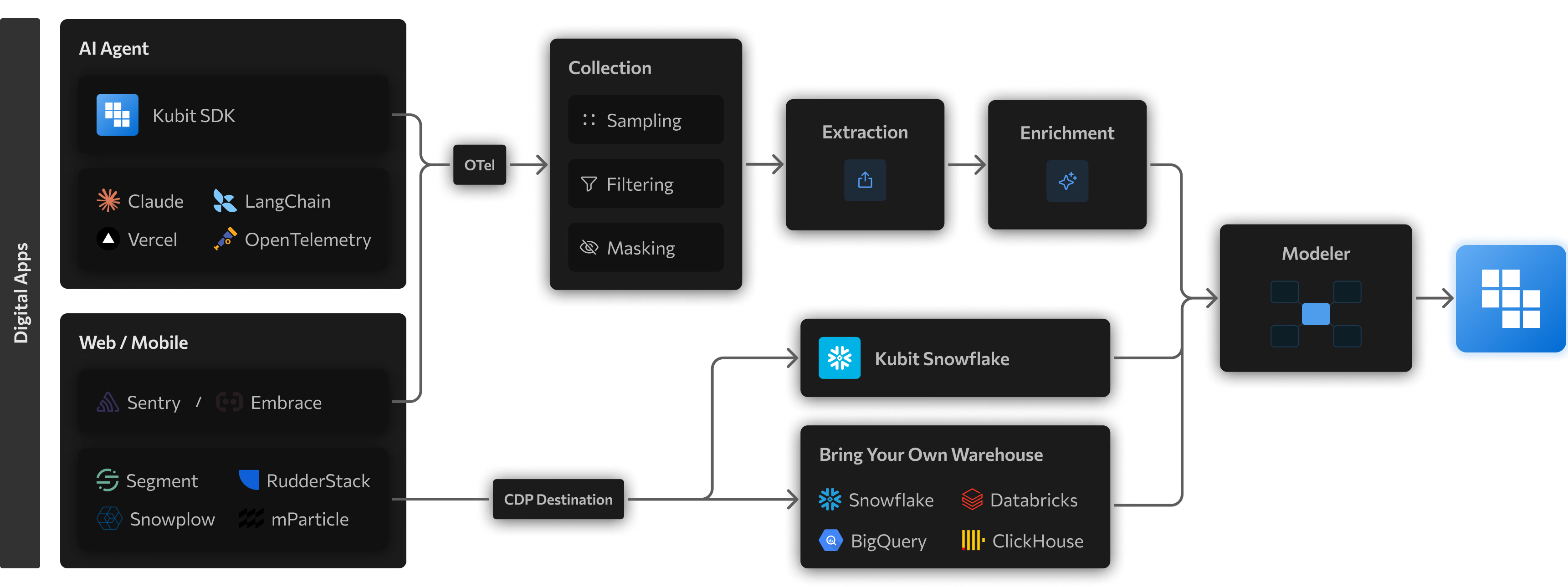
You get data into Kubit in several ways:
Ingest via OpenTelemetry. Send traces to the OTLP endpoint and Kubit handles processing and storage for you. You can be live in minutes with no warehouse setup. See Integrate your App.
CDP Destination: Config Kubit as a destination in your Customer Data Platform like Segment, Snowplow, Rudderstack or mParticle. If you already have a warehouse storing CDP data, choose the warehouse-native option below.
Bring Your Own Warehouse. Point Kubit at your cloud data warehouse like Snowflake, Databricks, BigQuery, ClickHouse, or Redshift. Kubit runs its queries against your traces, events and BI schema, nothing is copied out, and your governance stays in force.
You choose the path when you create a workspace: an OpenTelemetry workspace ingests traces for you, a Warehouse workspace queries data in place. Each workspace also targets a behavior type, Agent or User, so you can model both kinds of activity in the same account.
Sending data to your own warehouse is an option, not a requirement. Many teams start with OpenTelemetry ingestion and move to direct warehouse query when they want a single source of truth in their own environment.
Bring Your Own Warehouse
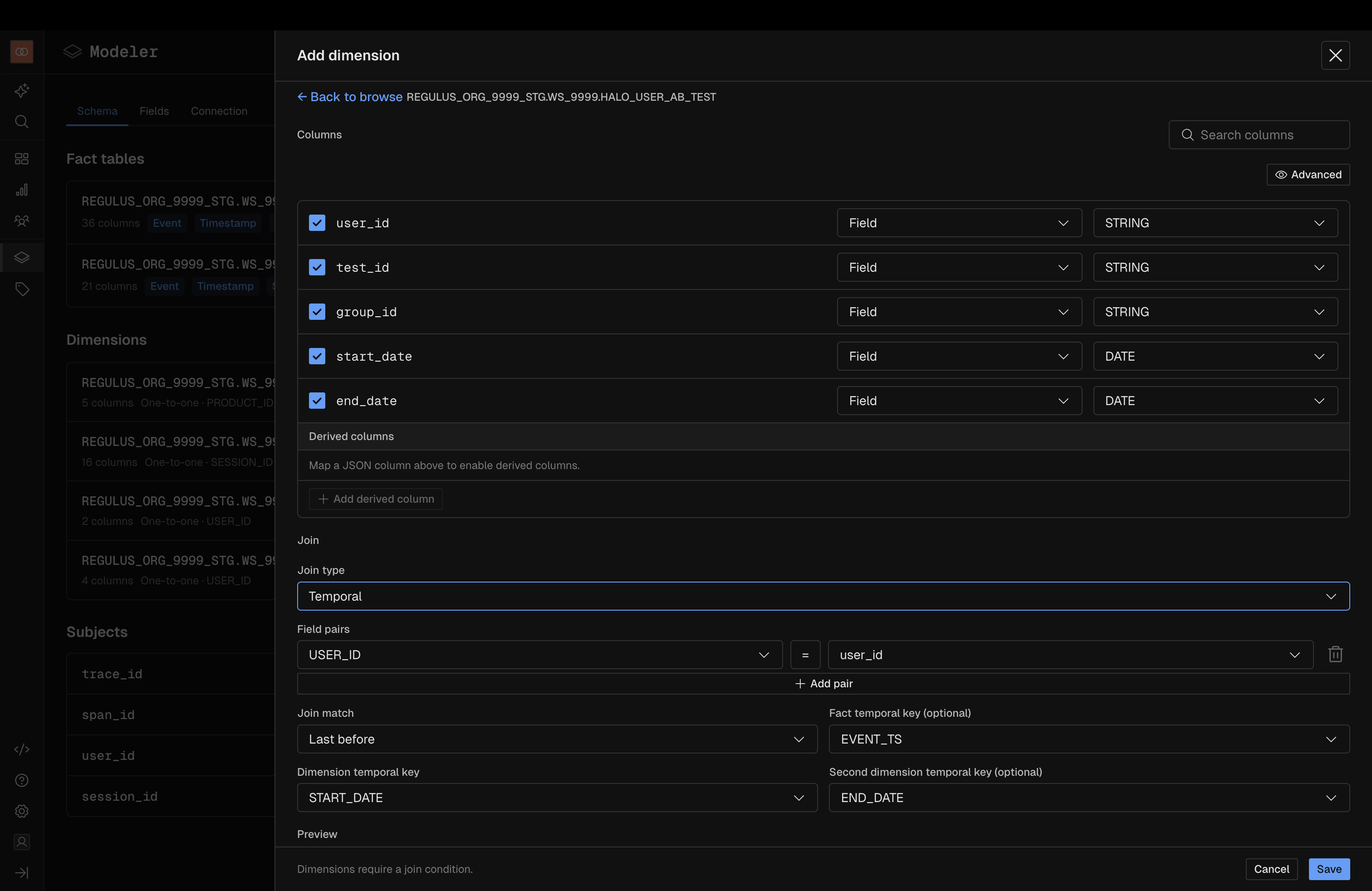
When traces land in your warehouse, the whole path from raw span to analyzed metric stays in your environment. Ingestion writes traces to your tables, Conversation Intelligence writes intent, sentiment, and resolution back to those same tables, and Kubit reads from there.
That model gives you:
No data movement. Traces and derived metrics stay put. There is no ETL job to break, backfill, or pay duplicate storage for.
One source of truth. The numbers in Kubit are the numbers in your warehouse. A notebook, a BI tool, or another team querying the same tables sees the same data.
Your governance. Access runs through a read only account you provision. Row level security, masking, and audit logging are enforced by the warehouse.
Full resolution, no sampling. Because compute runs in your warehouse, Kubit enriches and queries 100% of your traces.
Real time, not a snapshot. Queries hit live tables, so a trace that landed minutes ago is ready to analyze.
A path to unify. Once traces sit alongside your clickstream, billing, and CRM tables, you can join them. This is the foundation for Unified Analytics.
You can also call your warehouse's built in AI functions (Snowflake Cortex, BigQuery, Databricks) inside derived fields to analyze unstructured trace text in place.
Setting it Up
Provision a read only account for Kubit, scoped to the schema holding your traces.
Allowlist Kubit's IP addresses in your warehouse firewall.
Point trace ingestion at your warehouse. Your Kubit contact configures this per warehouse.
Direct connect setup is specific to each warehouse. See the guides for Snowflake, BigQuery, Databricks, and ClickHouse.
Next steps
Unify agent and product data: Unified Analytics
See how traces are enriched: Conversation Intelligence
Send your traces to Kubit: Integrate your App