
Overview
Kubit is a Product Analytics platform connecting Agent actions and User behavior: you analyze how users interact with your AI agents and what they do in your app as a single dataset, not two disconnected ones. Bring data in however suits each surface, ingest via OpenTelemetry, CDP or Bring Your Own Warehouse, and it resolves into the same model.
The Problem
Most teams analyze agents in one tool and their web or mobile product in another, and the two never join. You can see that an agent session ended in frustration. You can see that a user churned. You can't connect them, because they live in separate systems with separate identities, metrics, and event definitions.
That gap hides the questions that matter most:
How much did the Shopping Agent contribute to sales growth?
Which resolved intents correlate with higher retention?
Which users churned after a bad chatbot experience, and can we reach them?
How Kubit Unifies the Data
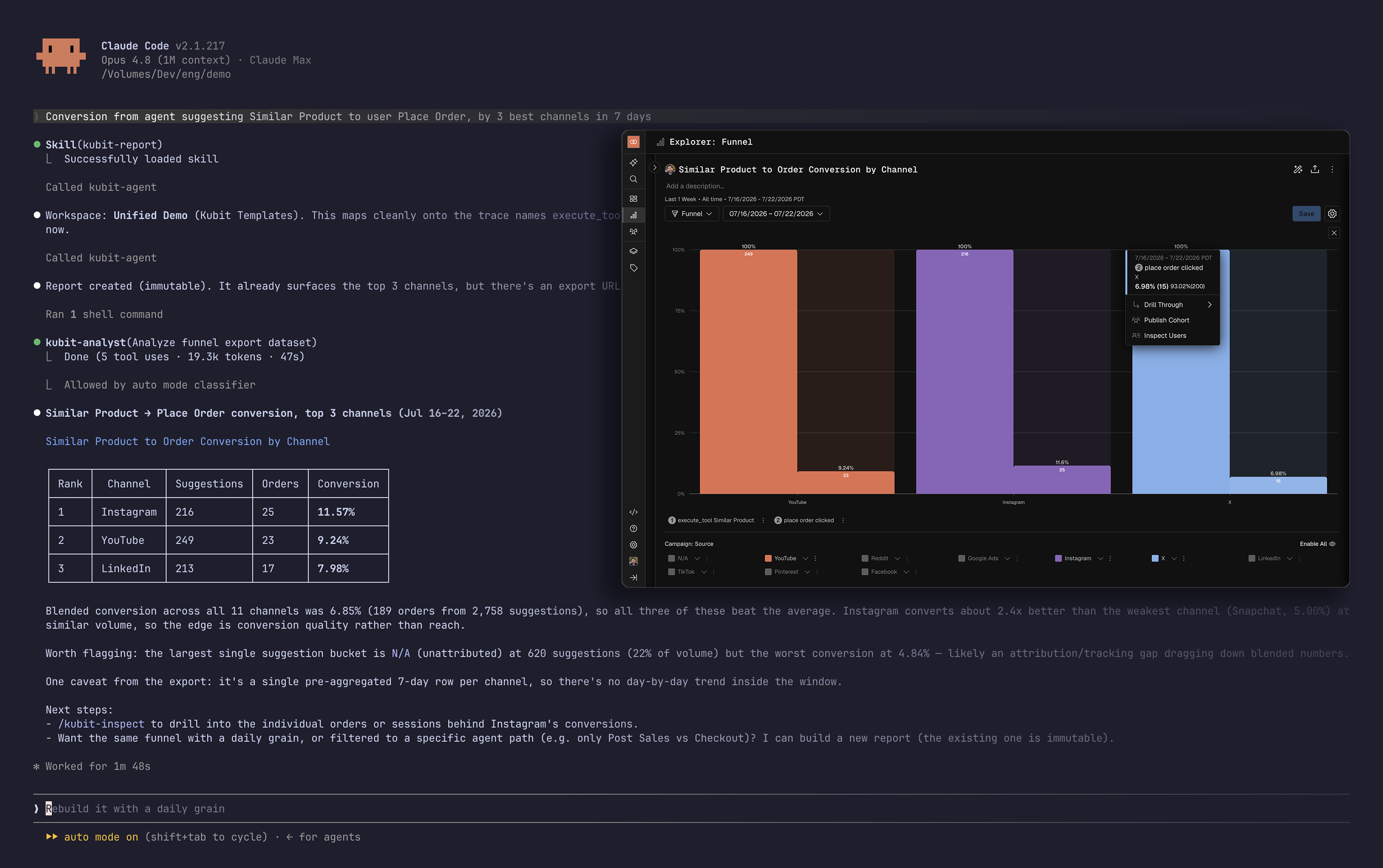
Kubit treats an LLM trace and a clickstream event as the same kind of object: a behavioral event tied to a user and a session. Agent action and user behavior come in as separate source views, and the Modeler unions them into one model joined to your shared dimensions. From there, both share one schema, resolve to the same user identity, and are queryable with the same Funnel, Flow, Retention, and Query reports.
One event model. Agent traces (with enriched intent, sentiment, and resolution) and product events (clicks, views, purchases) sit in one schema, so a single report can step across both.
One user identity. Someone who chatted with your agent and then bought in your app is one user in Kubit, not two.
One Single Source of Truth. With warehouse-native capabilities, both datasets land in the same cloud data warehouse, ready to join with no copying or reconciliation.
What it unlocks
With the data unified, the agent stops being a black box at the edge of your product and becomes a measurable step in the journey.
Attribution. Quantify an agent's contribution to revenue, conversion, or activation by joining agent sessions to the events that follow them.
Retention by experience. Build cohorts on agent behavior (resolved vs. unresolved, positive vs. negative sentiment, specific intents) and compare their retention against everyone else.
Cross surface funnels. Build a funnel that starts with a product event, passes through an agent interaction, and ends in a conversion, all in one report.
Closed loop action. Define a cohort like "users who churned after a negative agent session" and feed it to a re-engagement campaign.
Getting Started
Unified Product Analytics combines Agent Observability, Conversation Intelligence (intent, sentiment, resolution), and Behavior Analytics through OpenTelemetry, CDP or warehouse-native integration where clickstream events, agent traces and dimension tables can share a data mdoel. With all these in place, you can analyze cross-channel journeys holistically, identifying friction points where agent actions directly impact user retention, engagement, and conversion metrics.
Next Steps
Explore features for Agent Observability, Conversation Intelligence, and Behavior Analytics
Set up the foundation: Warehouse-native